> ## Documentation Index
> Fetch the complete documentation index at: https://documentation.onesignal.com/llms.txt
> Use this file to discover all available pages before exploring further.
# Web push webhooks
> Set up HTTP webhooks to receive real-time notifications when users display, click, or dismiss web push notifications. Complete guide with examples for Chrome, Firefox, and Safari browser support.
## Overview
Web push webhooks are client-side callbacks the browser fires through the OneSignal Web SDK whenever users interact with your **web push notifications** (displayed, clicked, or dismissed). The browser sends the notification data and any custom parameters to the webhook URL you configure per web app. You set them up in **Settings > Web** or in your Web SDK `init()` call.
**Most customers want [Event Streams](./event-streams), not web push webhooks.** Event Streams sends message events (sent, clicked, bounced, and more) across every channel to your servers in real time, and is the recommended way to get OneSignal data into your own systems. Web push webhooks are an older, browser-only feature kept for teams that specifically need client-side web push callbacks.
**Key Benefits:**
* Track notification engagement in real-time
* Trigger automated workflows based on user interactions
* Sync notification data with your analytics platform
* Implement custom business logic for notification events
## Which webhook do you need?
OneSignal has several distinct features that are commonly called "webhooks". They live in different places and do different things. This page covers **web push webhooks**: browser-side callbacks that fire only for web push interactions. They do **not** apply to mobile app push, email, SMS, in-app messages, or server-side events. For most integrations, use [Event Streams](./event-streams). To choose between the options:
| Feature | Use it when you want to... | Where it's configured |
| ---------------------------------------------- | ----------------------------------------------------------------------------------------------------- | ------------------------------------------------------------------ |
| [Event Streams](./event-streams) (recommended) | Stream message events across all channels (sent, clicked, bounced, etc.) to your systems in real time | **Data > Event Streams** |
| [Journey webhooks](./journeys-webhook) | Send an HTTP request to your server when a user reaches a step in a Journey | **Data > Webhooks**, then added to a Journey with the Webhook node |
| Web push webhooks (this page) | Receive browser callbacks when web push notifications are displayed, clicked, or dismissed | **Settings > Web**, or the Web SDK `init()` call |
## Browser Support
| Browser | Platform Support | Webhook Events Available |
| ------- | ----------------------- | ------------------------------------ |
| Chrome | macOS, Windows, Android | All events (display, click, dismiss) |
| Firefox | macOS, Windows, Android | Display and click events |
| Safari | Not supported | None |
## Available Webhook Events
### notification.willDisplay
Triggered immediately after a notification appears on the user's screen.
**Use cases:** Track delivery rates, log impression data, trigger follow-up campaigns
### notification.clicked
Triggered when a user clicks on the notification body or any action button.
**Use cases:** Track engagement rates, trigger conversion events, redirect users to specific content
### notification.dismissed
Triggered when a user actively dismisses a notification or when it expires automatically.
**Browser support:** Chrome only
**Use cases:** Track dismissal rates, optimize notification timing, A/B test notification content
**Important:** Clicking the notification body or action buttons does NOT trigger the dismissed webhook.
## Setup Methods
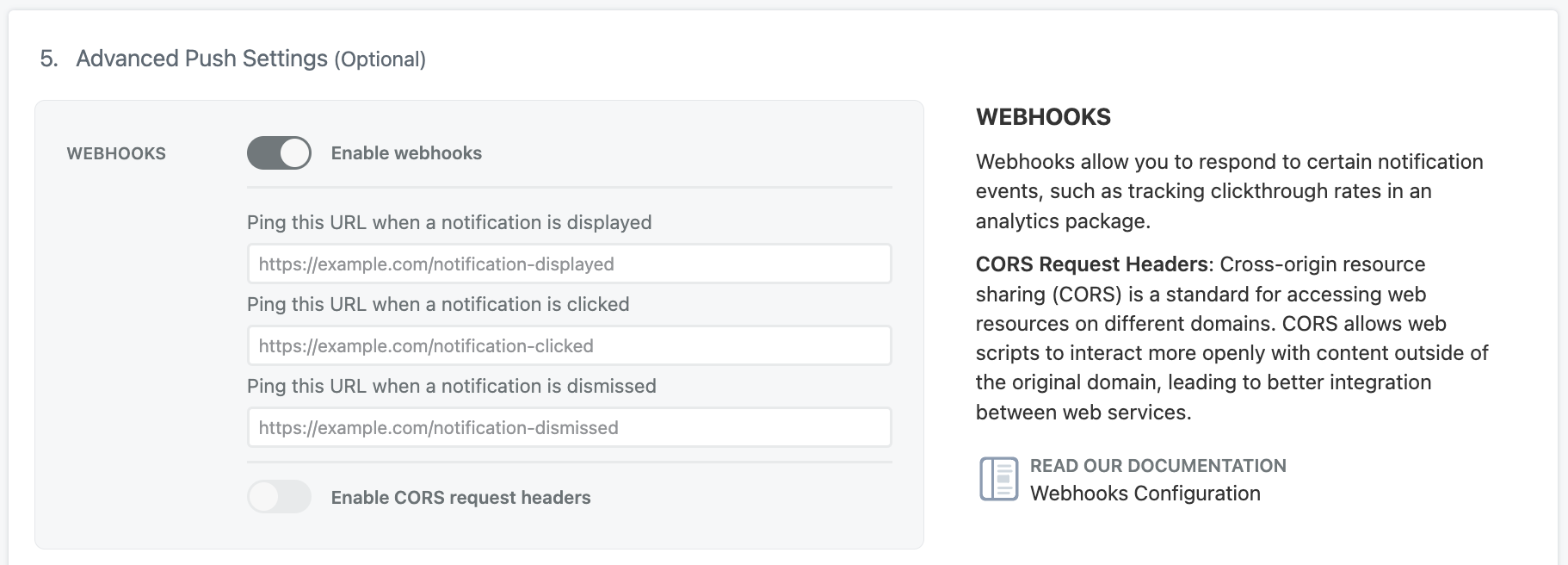
Navigate to **Settings > Web** in your OneSignal dashboard
Enable the "Enable webhooks" toggle
Enter your webhook URLs for each event you want to track
 Add webhook configuration to your existing `OneSignal.init()` method:
```javascript theme={null}
// Add to your existing OneSignal initialization - do NOT call init twice
OneSignal.init({
// Your other existing settings here
webhooks: {
cors: false, // Recommended: leave as false unless you need custom headers
'notification.willDisplay': 'https://yoursite.com/webhook/display',
'notification.clicked': 'https://yoursite.com/webhook/click',
'notification.dismissed': 'https://yoursite.com/webhook/dismiss' // Chrome only
}
});
```
Make sure your webhook URLs are HTTPS (required by Chrome's security policies).
## CORS Configuration
The `cors` setting determines what headers and data your webhook endpoint receives:
* **`cors: false` (Recommended):** Simpler setup, no CORS configuration needed on your server
* **`cors: true`:** Provides additional headers but requires CORS support on your server
**When to use `cors: true`:**
* You need the `Content-Type: application/json` header
* You want the `X-OneSignal-Event` header for easier event identification
* Your server already supports CORS for non-simple requests
## Webhook Request Format
### Standard Request (cors: false)
Your webhook endpoint receives a POST request with this payload structure:
```json theme={null}
{
"event": "notification.clicked",
"notificationId": "ed46884e-0e3f-4373-9e11-e28f27746d3d",
"heading": "Your notification title",
"content": "Your notification message",
"additionalData": {
"userId": "12345",
"campaignId": "summer-sale",
"customField": "customValue"
},
"actionId": "buy-now-button",
"url": "https://yoursite.com/product/123"
}
```
### Enhanced Request (cors: true)
Same payload as above, plus these additional headers:
```http theme={null}
Content-Type: application/json
X-OneSignal-Event: notification.clicked
```
## Payload Field Reference
| Field | Type | Description | Always Present |
| ---------------- | ------ | ---------------------------------------------------------------------- | ----------------- |
| `event` | string | Event type that triggered the webhook | ✅ |
| `notificationId` | string | Unique OneSignal notification identifier | ✅ |
| `heading` | string | Notification title | Only if provided |
| `content` | string | Notification message body | Only if provided |
| `additionalData` | object | Custom data sent with notification | Only if provided |
| `actionId` | string | ID of clicked action button (empty string = notification body clicked) | Click events only |
| `url` | string | Launch URL for the notification | Only if provided |
| `subscriptionId` | string | OneSignal user/subscription ID | CORS enabled only |
## Implementation Best Practices
### Webhook Endpoint Requirements
**Security:**
* Use HTTPS URLs only (HTTP URLs will be blocked by Chrome)
* Implement proper authentication/validation for your webhook endpoints
* Consider rate limiting to handle high-volume notifications
**Response Requirements:**
* Return HTTP 200 status for successful processing
* Respond within 10 seconds to avoid timeouts
* Handle duplicate webhook calls gracefully (implement idempotency)
### Error Handling
```javascript theme={null}
// Example webhook endpoint (Node.js/Express)
app.post('/webhook/notification', (req, res) => {
try {
const { event, notificationId, additionalData } = req.body;
// Validate required fields
if (!event || !notificationId) {
return res.status(400).json({ error: 'Missing required fields' });
}
// Process the webhook data
processNotificationEvent(req.body);
// Always respond with 200 OK
res.status(200).json({ success: true });
} catch (error) {
console.error('Webhook processing error:', error);
res.status(500).json({ error: 'Internal server error' });
}
});
```
## Common Issues and Solutions
### Webhooks Not Firing
**Possible causes:**
* Webhook code not present on all pages with OneSignal initialization
* User hasn't visited a page with webhook code after it was added
* HTTPS requirement not met
* Server returning non-200 status codes
**Solution:** Ensure webhook configuration is included in your OneSignal init code on all pages where notifications are active.
### Missing Data in Webhooks
**Cause:** Webhooks only track events for users who visit pages with the webhook configuration active.
**Solution:** Deploy webhook code to all pages with OneSignal, not just specific landing pages.
### Duplicate Webhook Calls
**Cause:** Network issues or browser behavior may cause duplicate requests.
**Solution:** Implement idempotency using the `notificationId` field to deduplicate events.
## Webhook Limitations
* **One webhook URL per event:** You cannot set multiple webhook URLs for the same event type
* **HTTPS only:** HTTP URLs will not work due to browser security restrictions
* **Chrome-only dismissal tracking:** The `notification.dismissed` event only works in Chrome
* **Page dependency:** Users must visit pages with webhook code active for tracking to work
## Testing Your Webhooks
1. **Send a test notification** through your OneSignal dashboard
2. **Monitor your webhook endpoint** for incoming requests
3. **Verify payload structure** matches your expectations
4. **Test different scenarios:**
* Notification display
* Clicking notification body
* Clicking action buttons (if configured)
* Dismissing notifications (Chrome only)
## Next Steps
After setting up webhooks, consider:
* **Analytics Integration:** Forward webhook data to your analytics platform
* **User Segmentation:** Use webhook events to create user segments based on engagement
* **Automated Workflows:** Trigger email campaigns or app notifications based on push notification interactions
* **A/B Testing:** Use webhook data to measure the effectiveness of different notification strategies
Add webhook configuration to your existing `OneSignal.init()` method:
```javascript theme={null}
// Add to your existing OneSignal initialization - do NOT call init twice
OneSignal.init({
// Your other existing settings here
webhooks: {
cors: false, // Recommended: leave as false unless you need custom headers
'notification.willDisplay': 'https://yoursite.com/webhook/display',
'notification.clicked': 'https://yoursite.com/webhook/click',
'notification.dismissed': 'https://yoursite.com/webhook/dismiss' // Chrome only
}
});
```
Make sure your webhook URLs are HTTPS (required by Chrome's security policies).
## CORS Configuration
The `cors` setting determines what headers and data your webhook endpoint receives:
* **`cors: false` (Recommended):** Simpler setup, no CORS configuration needed on your server
* **`cors: true`:** Provides additional headers but requires CORS support on your server
**When to use `cors: true`:**
* You need the `Content-Type: application/json` header
* You want the `X-OneSignal-Event` header for easier event identification
* Your server already supports CORS for non-simple requests
## Webhook Request Format
### Standard Request (cors: false)
Your webhook endpoint receives a POST request with this payload structure:
```json theme={null}
{
"event": "notification.clicked",
"notificationId": "ed46884e-0e3f-4373-9e11-e28f27746d3d",
"heading": "Your notification title",
"content": "Your notification message",
"additionalData": {
"userId": "12345",
"campaignId": "summer-sale",
"customField": "customValue"
},
"actionId": "buy-now-button",
"url": "https://yoursite.com/product/123"
}
```
### Enhanced Request (cors: true)
Same payload as above, plus these additional headers:
```http theme={null}
Content-Type: application/json
X-OneSignal-Event: notification.clicked
```
## Payload Field Reference
| Field | Type | Description | Always Present |
| ---------------- | ------ | ---------------------------------------------------------------------- | ----------------- |
| `event` | string | Event type that triggered the webhook | ✅ |
| `notificationId` | string | Unique OneSignal notification identifier | ✅ |
| `heading` | string | Notification title | Only if provided |
| `content` | string | Notification message body | Only if provided |
| `additionalData` | object | Custom data sent with notification | Only if provided |
| `actionId` | string | ID of clicked action button (empty string = notification body clicked) | Click events only |
| `url` | string | Launch URL for the notification | Only if provided |
| `subscriptionId` | string | OneSignal user/subscription ID | CORS enabled only |
## Implementation Best Practices
### Webhook Endpoint Requirements
**Security:**
* Use HTTPS URLs only (HTTP URLs will be blocked by Chrome)
* Implement proper authentication/validation for your webhook endpoints
* Consider rate limiting to handle high-volume notifications
**Response Requirements:**
* Return HTTP 200 status for successful processing
* Respond within 10 seconds to avoid timeouts
* Handle duplicate webhook calls gracefully (implement idempotency)
### Error Handling
```javascript theme={null}
// Example webhook endpoint (Node.js/Express)
app.post('/webhook/notification', (req, res) => {
try {
const { event, notificationId, additionalData } = req.body;
// Validate required fields
if (!event || !notificationId) {
return res.status(400).json({ error: 'Missing required fields' });
}
// Process the webhook data
processNotificationEvent(req.body);
// Always respond with 200 OK
res.status(200).json({ success: true });
} catch (error) {
console.error('Webhook processing error:', error);
res.status(500).json({ error: 'Internal server error' });
}
});
```
## Common Issues and Solutions
### Webhooks Not Firing
**Possible causes:**
* Webhook code not present on all pages with OneSignal initialization
* User hasn't visited a page with webhook code after it was added
* HTTPS requirement not met
* Server returning non-200 status codes
**Solution:** Ensure webhook configuration is included in your OneSignal init code on all pages where notifications are active.
### Missing Data in Webhooks
**Cause:** Webhooks only track events for users who visit pages with the webhook configuration active.
**Solution:** Deploy webhook code to all pages with OneSignal, not just specific landing pages.
### Duplicate Webhook Calls
**Cause:** Network issues or browser behavior may cause duplicate requests.
**Solution:** Implement idempotency using the `notificationId` field to deduplicate events.
## Webhook Limitations
* **One webhook URL per event:** You cannot set multiple webhook URLs for the same event type
* **HTTPS only:** HTTP URLs will not work due to browser security restrictions
* **Chrome-only dismissal tracking:** The `notification.dismissed` event only works in Chrome
* **Page dependency:** Users must visit pages with webhook code active for tracking to work
## Testing Your Webhooks
1. **Send a test notification** through your OneSignal dashboard
2. **Monitor your webhook endpoint** for incoming requests
3. **Verify payload structure** matches your expectations
4. **Test different scenarios:**
* Notification display
* Clicking notification body
* Clicking action buttons (if configured)
* Dismissing notifications (Chrome only)
## Next Steps
After setting up webhooks, consider:
* **Analytics Integration:** Forward webhook data to your analytics platform
* **User Segmentation:** Use webhook events to create user segments based on engagement
* **Automated Workflows:** Trigger email campaigns or app notifications based on push notification interactions
* **A/B Testing:** Use webhook data to measure the effectiveness of different notification strategies